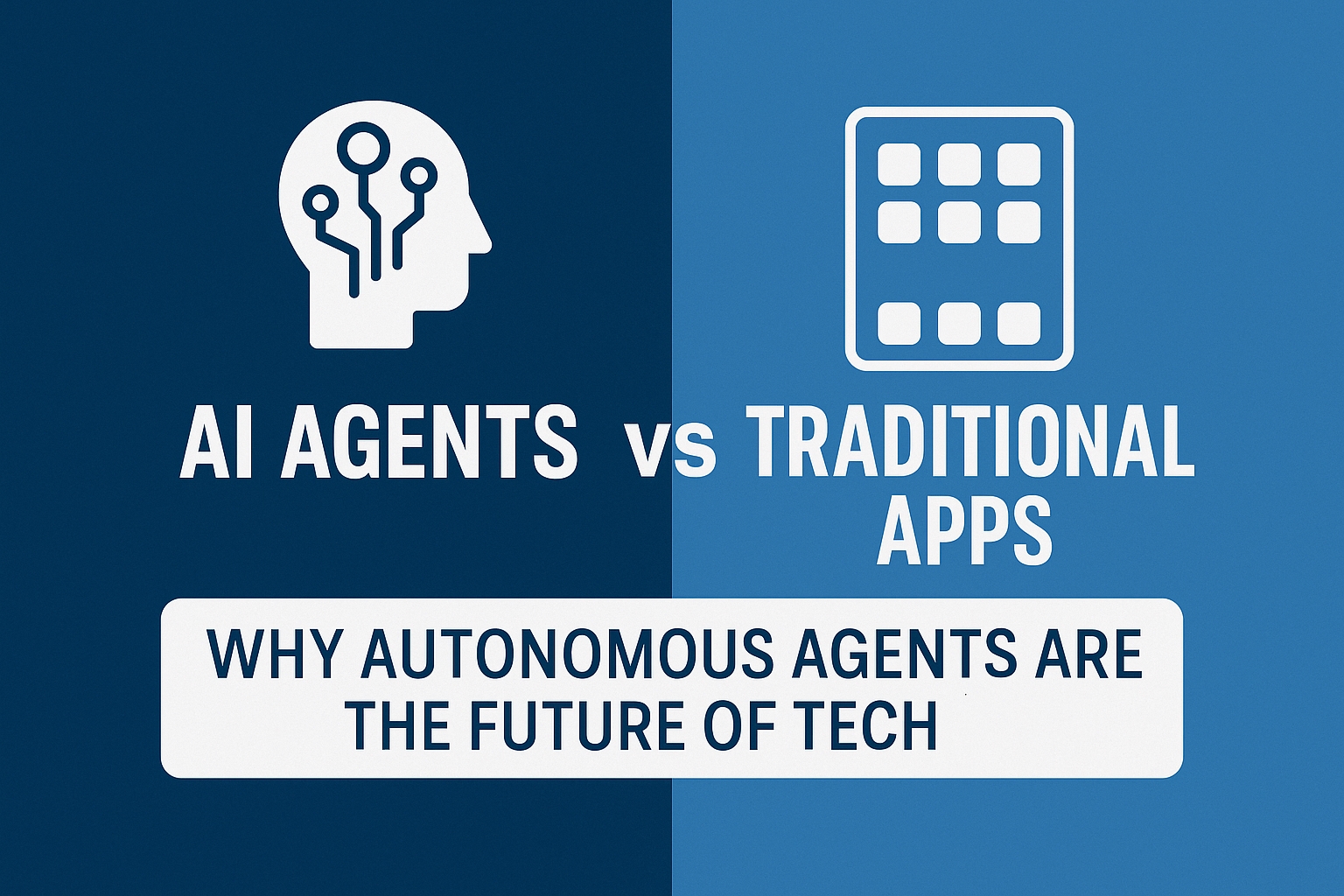
In 2025, the tech world is witnessing a radical shift—AI agents are starting to replace traditional apps in many areas of our digital lives. From personal productivity to business automation, autonomous AI systems are redefining how we interact with technology. But what exactly are AI agents, and how do they compare to the apps we’ve used for decades?
In this blog, we’ll break down the difference between AI agents and traditional apps, explore the advantages of autonomous systems, and explain why they’re quickly becoming the future of technology.
What Are AI Agents?
AI agents are intelligent, goal-oriented systems that can perform tasks independently without constant human input. Think of them as virtual employees that can plan, execute, and learn from tasks across multiple apps and environments.
Popular examples in 2025 include:
- Devin – the world’s first AI software engineer
- AutoGPT & BabyAGI – autonomous task managers powered by GPT models
- Personal AI Assistants like ChatGPT’s custom GPTs or Google’s Gemini
Unlike traditional apps, which require users to manually operate features, AI agents can take an objective and run with it—researching, planning, making decisions, and even improving over time.
Traditional Apps: Still Useful, But Limited
Traditional apps—such as task managers, design tools, or accounting software—are built with predefined features and user-driven workflows. While they offer stability and control, they depend heavily on manual input, switching contexts, and rigid workflows.
For example:
- You use Trello for tasks, Google Sheets for tracking, and Notion for notes—all separately.
- You manually copy data, set reminders, and manage notifications across apps.
This setup is time-consuming and fragmented, especially in an age of increasing digital complexity.
Key Differences: AI Agents vs Traditional Apps
| Feature | Traditional Apps | AI Agents |
|---|---|---|
| User Input | Required for every step | Minimal; just the objective |
| Automation | Limited to predefined workflows | Fully autonomous, adaptive |
| Integration | Often siloed | Seamlessly integrates across tools |
| Learning Ability | Static features | Can learn and improve over time |
| Scalability | Manual scaling | Scales with minimal effort |
Why AI Agents Are the Future
- Increased Productivity
AI agents can handle complex multi-step workflows without user micromanagement, saving hours daily. - Smarter Decision-Making
These systems leverage advanced models (like GPT-4o and Gemini) to make contextual, data-driven decisions. - 24/7 Availability
AI agents don’t sleep—they can manage tasks, respond to queries, or analyze data around the clock. - Personalization
With continuous learning, AI agents can tailor workflows to your habits, preferences, and goals. - Cost-Efficiency
Businesses can replace multiple tools and reduce labor costs by automating entire departments.
Real-World Use Cases in 2025
- Marketing Teams use AI agents to research trends, draft content, schedule posts, and analyze engagement.
- Developers rely on agents like Devin to write code, test apps, and document projects.
- Entrepreneurs use agents to manage emails, schedule meetings, and handle customer support autonomously.
Are Traditional Apps Going Away?
Not yet—but they are evolving. Many software companies are now embedding AI agents inside traditional apps to stay competitive. Instead of choosing one over the other, expect a hybrid model in the near future.
Final Thoughts: Embrace the Shift
AI agents are not just a trend—they’re a paradigm shift in how we use technology. By combining automation, intelligence, and adaptability, they are reshaping productivity and making our digital tools smarter than ever.
If you want to stay ahead in tech, now is the time to explore how AI agents can boost your work or business.